
I. Introduction
Ben tre is a well-known province with the largest coconut plantation area in Viet Nam. This is ideal for coconut growing. Many products are made from coconut for local market and exportation, contributing a large part to income and employment for indigenous people.
Coconut jelly (known as Nata de Coco) is a product from fermentative action of Acetobacter xylinum- a thick translucent, gelatinous food product. Nata de coco can be sweetened as desserts or candies. It is commonly used as an ingredient in sweet fruit salads, pickles, fruit cocktails, drinks, ice cream, gourmet dishes and other recipes. Nata de Coco is one of the highest sources of insoluble dietary fiber, carbohydrate, vitamins and minerals, no cholesterol and low in fat. From raw coconut jelly with 100% cellulose, we can produce foods with the main ingredients are coconut jelly. Especially the mask type in cosmetic is made from raw coconut jelly.
At present, our factory is capable of supplying a large quantity of raw coconut jelly during the day (more than 10 tons per day). Nata de Coco slabs can be cut into small tablets, large pieces or cubes (as customer requirement) and be dry pressed to facilitate transportation and storage longer.
II. How to produce raw Nata De Coco
Ingredients that are used to produce Nata de Coco include coconut water, refined sugar, Amoni sulfat (SA), Citric acid, Acetic acid and Nata starter (Acetobacter xylinum). Amoni sulfat function is as nutrient for Acetobacter xylinum. Citric acid and acetic acid contribute to the pH 3-4 of solutions (acidulant). During the production of Nata de Coco, Acetobacter xylinum metabolizes glucose in the coconut water that acts as a carbon source and converts it into extracellular cellulose as metabolites (Santosa et al., 2012).
Acetobacter xylinum (a gram negative bacterium) is the living organism that carries out the fermentation of Nata de Coco. Nata de Coco is a bacterial cellulose that forms over a sugary medium made by Acetobacter xylinum. Several species including acetic acid bacteria can form the cellulose, but the most commonly used is Acetobacter xylinum (Industrial Technology Development Institute – DOST, 2007; Nadia et al., 2012).
Microbial starter culture is the most important ingredient in the formation of Nata de Coco. At the factory, post-fermentation liquid is used where it’s a common practice to prepare a culture starter by separating a small portion of Nata medium formula and allowing it to ferment for 3-5 days before it is used as starter.
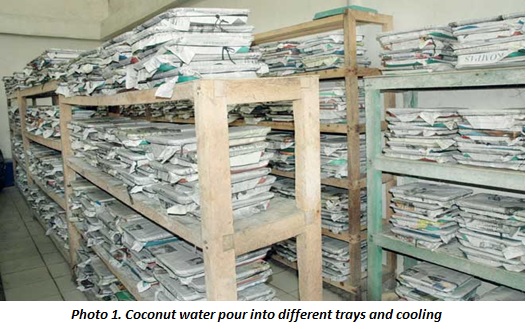
The production and harvesting process of Nata de Coco as below chart:

III. How to produce the dry pressed Nata de Coco
After washed up raw Nata de Coco until it is clean and white, Nata de Coco slabs will be cut into small cubes with different sizes (e.g 12mm, 15mm, …) or slide into thin layers used as mask types in cosmetic industry.

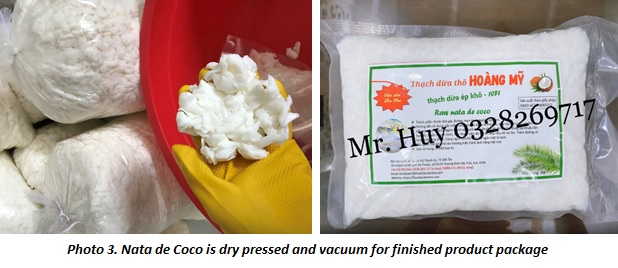
Nata de Coco cubes continue to be dry pressed until reach to 1:10 ratio (from 1kg dry pressed Nata de Coco can be bulged into 10kg raw Nata de Coco after soaking into water).
Finished product package will be vacuumed and transported or exported to customer.
In conclusion, Nata de Coco is low in calories and high in dietary fiber which is good for diet purposes. It can be served as a dessert in its sweetened form. Nata de coco is popularly used as ingredients in ice cream and other fruit preparations such as cocktails and salads.
About us: Hoang My Co., LTD has been established since 2010 with capacity around 3 tons per day at that time. After more than 10 years developed continuously, Hoang My can supply to the market over 10 tons raw Nata de Coco per day. Beside slabs of Nata de Coco, we also produce small cubes and pressed product with different sizes depend on customer’s requirement. With manpower of nearly 15 people, our company has created jobs for indigenous people and also contributed to the development of coconut jelly production in Ben Tre.
PLEASE NOTE: All information contained in this publication are based on the company’s manufacturing and development networks. This process may be different in other country. Hoang My Co., Ltd reserves the right to change or modify this process in a continuing effort to improve our products in order to meet customer needs.
HOANG MY CO., LTD.
Website: https://thachduabentre.com
Address: 53A, Hamlet My An A, My Thanh An Village, Bentre City, Vietnam
Tel: (+84) 275 3811335 | (+84) 328269717 | (+84) 984211269
Email: kinhdoanh@thachduabentre.com
Leave a Reply